
Imagine you’re hauling a full load down the highway when your truck suddenly struggles to accelerate. The engine feels sluggish, maintaining speed becomes difficult, and warning lights may appear on the dashboard. This situation is more than frustrating—it can create serious safety risks, increase fuel consumption, and lead to expensive roadside breakdowns.
Truck losing power while driving is one of the most common issues experienced by commercial truck drivers and fleet operators. The problem can develop gradually or occur without warning, and it often points to an underlying issue within the fuel system, turbocharger, air intake, emissions system, or engine management system.
Ignoring truck losing power while driving can result in reduced engine performance, poor fuel efficiency, increased wear on critical components, and even complete engine failure. Identifying the warning signs early allows you to address minor issues before they become major repairs.
Whether you operate a single heavy-duty truck or manage an entire fleet, understanding the causes of truck losing power while driving can help you reduce downtime, improve reliability, and keep your vehicles operating safely.
If your truck is experiencing persistent power loss, professional diagnostics are essential. The experienced technicians at Heavy Truck Repair in Barrie use advanced diagnostic equipment to identify the exact cause and perform reliable repairs before the issue worsens.
What Does It Mean When a Truck Is Losing Power While Driving?
When a truck loses power, the engine is unable to produce the horsepower or torque needed to perform efficiently. Instead of delivering smooth acceleration, the engine struggles under load, especially when climbing hills, overtaking traffic, or carrying heavy cargo.
The symptoms may include:
- Slow or delayed acceleration
- Difficulty maintaining highway speeds
- Reduced pulling power under heavy loads
- Increased fuel consumption
- Black, white, or blue exhaust smoke
- Check Engine Light illumination
- Engine entering limp mode
- Rough engine performance
- Excessive turbo lag
- Reduced throttle response
Modern diesel engines rely on dozens of sensors, electronic control modules, turbochargers, emissions components, and high-pressure fuel systems. A problem with just one component can reduce overall engine performance and trigger truck losing power while driving.
Fortunately, most power loss issues can be identified through professional diagnostics before they lead to costly engine damage.
Common Causes of Truck Losing Power While Driving
Several mechanical and electronic systems work together to produce engine power. When one system fails, your truck’s performance suffers.
Below are the most common causes.
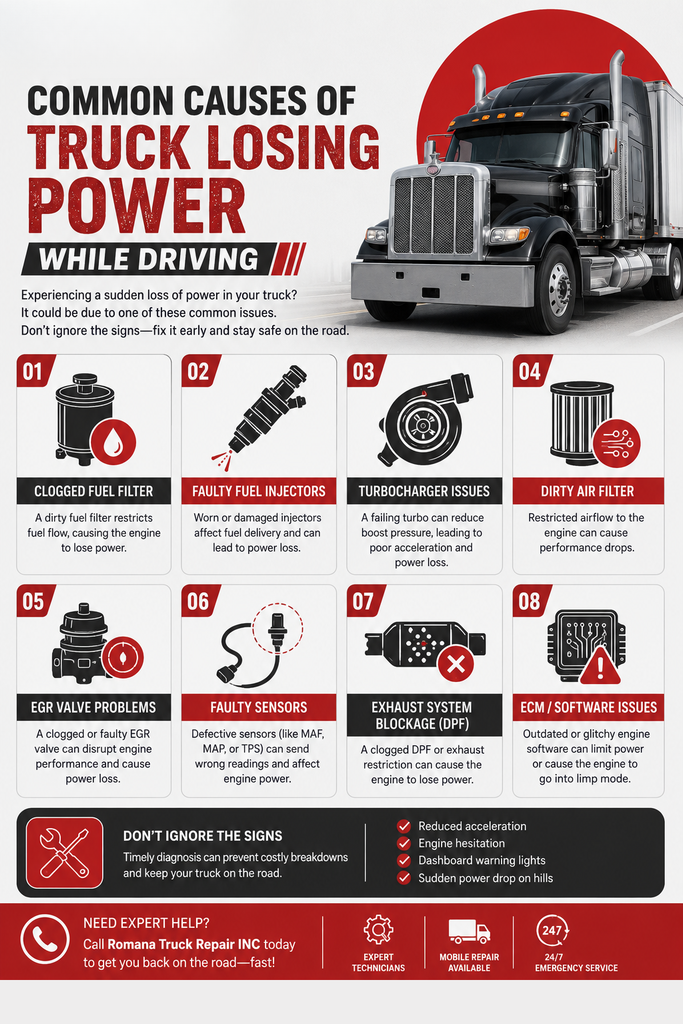
1. Clogged Fuel Filter Restricting Diesel Flow
A clogged fuel filter is one of the leading causes of truck losing power while driving, particularly in diesel-powered commercial trucks.
The fuel filter removes dirt, rust, water, and contaminants before diesel reaches the high-pressure fuel injection system. Over time, contaminants accumulate inside the filter, restricting fuel flow to the engine.
When the engine cannot receive enough fuel, combustion becomes inefficient, causing noticeable power loss.
Common symptoms include:
- Poor acceleration
- Engine hesitation
- Reduced fuel pressure
- Hard starting
- Engine stalling
- Lower fuel economy
Ignoring a clogged fuel filter can also damage expensive components such as fuel injectors and the high-pressure fuel pump.
Prevention Tips
- Replace fuel filters according to manufacturer recommendations.
- Purchase diesel fuel from trusted suppliers.
- Drain water separators regularly.
- Include fuel system inspections in preventive maintenance schedules.
Replacing a fuel filter is relatively inexpensive compared to repairing a damaged fuel injection system.
2. Dirty or Restricted Air Filter
Your diesel engine requires a precise balance of fuel and clean air to generate power.
When the air filter becomes clogged with dirt, dust, insects, or road debris, airflow into the engine decreases significantly. Less oxygen means incomplete combustion, causing the engine to feel weak and unresponsive.
Commercial trucks operating on construction sites, gravel roads, or dusty highways are especially susceptible to clogged air filters.
Warning signs include:
- Slow throttle response
- Black exhaust smoke
- Increased fuel consumption
- Reduced engine performance
- Turbocharger working harder than normal
Replacing an air filter is one of the simplest maintenance tasks that can restore lost engine performance.
Professional inspections often include checking both the primary and secondary air filters to ensure unrestricted airflow.
3. Turbocharger Problems
Turbochargers dramatically increase diesel engine power by forcing compressed air into the combustion chamber.
When the turbocharger begins to fail, engine performance drops quickly.
A failing turbo may suffer from:
- Worn bearings
- Oil contamination
- Damaged compressor blades
- Boost leaks
- Wastegate failure
- Broken intercooler hoses
Because heavy-duty diesel engines rely heavily on turbo boost, even a small leak can cause noticeable truck losing power while driving.
Common turbocharger symptoms
- Whistling noises
- Poor acceleration
- Reduced boost pressure
- Black smoke
- Excessive oil consumption
- Loss of pulling power
Professional diagnostic scanners can monitor boost pressure and quickly determine whether the turbocharger is performing correctly.
4. Fuel Injector Problems
Modern diesel injectors deliver fuel at extremely high pressure with precise timing.
Over time, injectors can become clogged with carbon deposits or wear internally, affecting fuel delivery.
When one or more injectors fail, combustion becomes uneven, reducing engine power and increasing fuel consumption.
Symptoms include:
- Rough idle
- Engine knocking
- Hard starting
- Excessive smoke
- Poor fuel economy
- Reduced acceleration
Injector problems should never be ignored because improper fuel delivery can eventually damage pistons, valves, and other engine components.
Routine fuel system maintenance significantly reduces injector failures.
5. Clogged Diesel Particulate Filter (DPF)
The Diesel Particulate Filter (DPF) captures soot before it leaves the exhaust system.
As soot accumulates, the filter periodically regenerates by burning the particles away. However, frequent short trips, interrupted regeneration cycles, or engine problems can prevent proper cleaning.
A blocked DPF creates excessive exhaust backpressure, making truck losing power while driving a common symptom.
Warning signs include:
- DPF warning light
- Engine entering limp mode
- Reduced acceleration
- Increased fuel consumption
- High exhaust temperatures
- Frequent regeneration attempts
Ignoring DPF issues can eventually require costly filter replacement.
Professional technicians can perform forced regeneration, inspect sensors, and identify the root cause of repeated DPF blockages instead of simply clearing fault codes.
6. Faulty Mass Air Flow (MAF) Sensor
The Mass Air Flow (MAF) sensor measures the amount of air entering the engine and sends this information to the Engine Control Module (ECM). The ECM uses this data to calculate the correct amount of fuel needed for efficient combustion.
If the MAF sensor becomes dirty or starts to fail, it can send incorrect readings. This causes an improper air-fuel mixture, leading to poor engine performance and truck losing power while driving.
Common symptoms include:
- Poor acceleration
- Rough idling
- Increased fuel consumption
- Check Engine Light
- Engine hesitation
- Reduced throttle response
Dust, oil residue, and debris are common reasons for MAF sensor contamination, especially in trucks operating in construction zones or dusty environments.
Prevention Tips
- Replace air filters regularly.
- Inspect the air intake system during scheduled maintenance.
- Clean or replace the MAF sensor when recommended by the manufacturer.
- Repair air intake leaks promptly.
7. Engine Entering Limp Mode
If your truck losing power while driving suddenly becomes extremely slow and refuses to accelerate beyond a certain speed, the engine may have entered Limp Mode.
Limp Mode is a protective feature designed to prevent severe engine or transmission damage. When the ECM detects a critical issue, it limits engine power to allow the truck to reach a repair facility safely.
Common triggers include:
- Turbocharger failure
- DPF blockage
- DEF system malfunction
- Overheating engine
- Faulty engine sensors
- Low fuel pressure
- Transmission problems
Signs your truck is in Limp Mode
- Sudden power loss
- Maximum speed is limited
- Check Engine Light illuminated
- Engine warning messages
- Poor acceleration
- Reduced RPM
Although Limp Mode helps prevent further damage, continuing to drive long distances is not recommended. Professional diagnostics are necessary to identify and repair the root cause.
8. DEF System or EGR Valve Problems
Modern commercial diesel trucks are equipped with emissions systems designed to reduce harmful exhaust gases.
Two of the most important components are:
- Diesel Exhaust Fluid (DEF) System
- Exhaust Gas Recirculation (EGR) Valve
When either system develops a fault, engine performance can be reduced significantly.
A clogged EGR valve restricts exhaust gas flow, while DEF system failures may trigger engine derating or Limp Mode.
Common symptoms
- Reduced engine performance
- Engine warning lights
- Poor fuel economy
- Excessive exhaust smoke
- Reduced acceleration
- Engine derating
Routine emissions system inspections can prevent costly repairs and help maintain compliance with environmental regulations.
9. Fuel Pump Failure
The diesel fuel pump supplies high-pressure fuel to the injectors.
If the pump cannot maintain adequate fuel pressure, the engine receives less fuel than required, resulting in truck losing power while driving, especially when accelerating or hauling heavy loads.
Symptoms include
- Difficulty starting
- Engine sputtering
- Loss of power under load
- Engine stalls
- Poor acceleration
- Increased fuel consumption
Ignoring fuel pump problems may eventually lead to complete engine shutdown.
Professional pressure testing can determine whether the pump is delivering the correct fuel pressure.
10. Electrical or Engine Control Module (ECM) Issues
Modern heavy-duty trucks rely heavily on electronic systems to control engine performance.
The Engine Control Module (ECM) communicates with dozens of sensors throughout the truck. If a sensor, wiring harness, or the ECM itself develops a fault, incorrect information may be sent to the engine.
As a result, truck losing power while driving can occur even though the mechanical components are functioning properly.
Possible electrical causes include
- Faulty throttle position sensor
- Crankshaft position sensor failure
- Camshaft sensor issues
- Wiring damage
- Poor electrical connections
- Faulty ECM programming
- Voltage problems
Electrical faults are often difficult to diagnose without specialized scan tools and manufacturer-specific software.
Warning Signs You Should Never Ignore
Many truck owners notice small performance issues long before complete power loss occurs. Recognizing these warning signs early can help prevent expensive repairs and unexpected roadside breakdowns.
Watch for the following symptoms:
- Difficulty accelerating
- Reduced pulling power while towing
- Loss of power on hills
- Excessive exhaust smoke
- Check Engine Light
- Poor fuel economy
- Rough idle
- Engine hesitation
- Turbo whistle or unusual noises
- Frequent DPF regeneration
- Engine overheating
- Hard starting
If multiple symptoms appear together, schedule a professional inspection immediately rather than waiting for the truck to break down.
How Professionals Diagnose Truck Losing Power While Driving
Finding the exact cause of truck losing power while driving requires more than simply replacing parts. Professional technicians follow a systematic diagnostic process to identify the root problem accurately.
A comprehensive inspection typically includes:
Computer Diagnostics
Advanced scan tools retrieve fault codes stored in the Engine Control Module (ECM). These codes provide valuable information about engine sensors, fuel delivery, turbocharger performance, emissions systems, and electrical components.
Fuel System Testing
Technicians measure fuel pressure, inspect filters, evaluate injectors, and verify that the fuel pump is operating within manufacturer specifications.
Turbocharger Inspection
The turbocharger, intercooler, boost hoses, and air intake system are inspected for leaks, excessive wear, damaged seals, or reduced boost pressure.
Air Intake System Inspection
Air filters, intake ducts, and the MAF sensor are checked to ensure the engine receives adequate airflow.
DPF and DEF System Evaluation
Diagnostic equipment measures soot accumulation, regeneration status, DEF quality, and emissions system performance to identify restrictions that may reduce engine power.
Road Test
After repairs or inspections, technicians perform a controlled road test to confirm that acceleration, power delivery, and overall engine performance have returned to normal.
Using advanced diagnostic equipment allows technicians to identify the true cause of truck losing power while driving, reducing unnecessary parts replacement and minimizing vehicle downtime.
Preventive Maintenance Can Prevent Power Loss
Many causes of truck losing power while driving can be avoided through routine preventive maintenance.
A proactive maintenance schedule not only improves reliability but also reduces repair costs, extends engine life, and keeps commercial trucks operating efficiently.
Preventive maintenance checklist
- Replace fuel filters on schedule.
- Inspect and replace air filters regularly.
- Use high-quality diesel fuel.
- Monitor turbocharger performance.
- Complete DPF regeneration when required.
- Maintain proper DEF levels.
- Inspect fuel injectors periodically.
- Check engine sensors during routine service.
- Monitor cooling system performance.
- Perform regular computer diagnostics.
Keeping detailed maintenance records also helps fleet managers identify recurring issues before they develop into major failures.
What Should You Do If Your Truck Is Losing Power While Driving?
Experiencing truck losing power while driving can be stressful, especially when you’re hauling a heavy load or traveling on a busy highway. While the cause may be something minor, continuing to drive without understanding the problem could lead to severe engine damage, safety risks, or a complete breakdown.
If you notice a sudden loss of power, follow these steps:
1. Stay Calm and Reduce Speed Safely
Avoid sudden braking or aggressive steering. Turn on your hazard lights and gradually move to the shoulder or another safe location if traffic conditions allow.
If your truck still has enough power to continue driving, reduce your speed and avoid placing unnecessary strain on the engine.
2. Watch for Dashboard Warning Lights
Pay close attention to your instrument panel.
Important warning lights include:
- Check Engine Light
- DEF Warning Light
- DPF Warning Light
- Engine Temperature Warning
- Low Oil Pressure Warning
- Battery Charging Warning
These indicators can provide valuable clues about why your truck losing power while driving issue is occurring.
3. Listen for Unusual Sounds
Unusual noises often point to mechanical problems.
Watch for:
- Loud turbo whistling
- Grinding noises
- Engine knocking
- Air leaks
- Exhaust leaks
Never ignore new sounds that appear along with reduced engine performance.
4. Avoid Heavy Acceleration
If your truck has already lost power, pressing the accelerator harder usually won’t solve the problem.
Instead, it may:
- Increase engine temperatures
- Damage the turbocharger
- Cause additional stress on the transmission
- Increase fuel consumption
- Worsen existing mechanical failures
Drive only as far as necessary to reach a safe location or repair facility.
5. Schedule Professional Diagnostics Immediately
Modern commercial trucks contain sophisticated electronic systems that require specialized diagnostic equipment.
Even if your truck seems to recover after restarting the engine, the underlying problem may still exist.
Professional technicians can quickly determine whether the issue involves:
- Fuel delivery
- Turbocharger performance
- Engine sensors
- DPF restriction
- DEF system
- Electrical faults
- Engine Control Module (ECM)
Early diagnosis often prevents significantly more expensive repairs later.
Can You Continue Driving If Your Truck Is Losing Power?
This is one of the most common questions commercial truck drivers ask.
The answer depends on the severity of the problem.
You may be able to drive a short distance if:
- The truck accelerates normally after restarting.
- No warning lights remain illuminated.
- Engine temperature is normal.
- There are no unusual noises or smoke.
You should stop driving immediately if:
- The engine enters Limp Mode.
- Power continues to decrease.
- Thick black, blue, or white smoke appears.
- Engine temperature rises rapidly.
- Oil pressure warning appears.
- The truck struggles to maintain highway speed.
Driving with severe engine power loss can increase repair costs dramatically by damaging the turbocharger, injectors, pistons, emissions system, or transmission.
Why Professional Truck Diagnostics Matter
Commercial diesel engines are more advanced than ever before.
Replacing parts based on guesswork rarely solves the problem and often increases repair costs.
Professional diagnostics allow technicians to identify the exact cause of truck losing power while driving without unnecessary parts replacement.
Benefits of professional diagnostics include:
- Faster identification of the root cause
- Accurate repair recommendations
- Reduced downtime
- Improved fuel efficiency
- Longer engine life
- Prevention of repeat failures
- Better fleet reliability
Using manufacturer-approved diagnostic software also ensures repairs follow factory specifications.
Why Preventive Maintenance Is Better Than Emergency Repairs
Preventive maintenance is one of the most effective ways to avoid truck losing power while driving.
Routine inspections help technicians detect worn components before they fail unexpectedly.
Preventive maintenance typically includes:
- Fuel filter replacement
- Air filter inspection
- Turbocharger inspection
- Cooling system testing
- DPF inspection
- DEF system maintenance
- Computer diagnostics
- Belt and hose inspection
- Battery and charging system testing
- Engine performance evaluation
A scheduled maintenance program improves reliability, reduces operating costs, and keeps trucks on the road longer.
Expert Heavy Truck Repair in Barrie
If your commercial truck is losing power while driving, professional diagnostics should be your first step. Delaying repairs can allow minor issues to develop into costly engine failures, extended downtime, and unexpected roadside breakdowns.
At Romana Truck Repair INC, experienced technicians diagnose and repair a wide range of diesel engine performance issues, including fuel system faults, turbocharger problems, DPF restrictions, DEF system failures, electrical issues, and engine management faults. Using advanced diagnostic equipment, the team identifies the root cause quickly and recommends the most effective repair solution.
Whether you operate a single truck or manage an entire fleet, professional maintenance helps improve reliability, fuel efficiency, and overall vehicle performance.
If you’re looking for trusted Heavy Truck Repair in Barrie, Romana Truck Repair INC provides comprehensive commercial truck diagnostics and repair services to help keep your vehicles operating safely and efficiently.
Frequently Asked Questions
Why is my truck losing power while driving?
The most common causes include clogged fuel filters, failing fuel injectors, turbocharger problems, blocked DPF filters, faulty sensors, fuel pump issues, air intake restrictions, or electronic control system faults.
Can a clogged fuel filter cause power loss?
Yes. A clogged fuel filter restricts diesel flow to the engine, reducing fuel pressure and causing poor acceleration, hesitation, and engine power loss.
Can a bad turbocharger reduce engine power?
Yes. A damaged turbocharger cannot produce the required boost pressure, leading to slower acceleration, reduced pulling power, increased exhaust smoke, and poor fuel efficiency.
Is it safe to drive when my truck loses power?
It depends on the severity of the problem. If power loss is significant, warning lights appear, or the truck enters Limp Mode, you should stop driving as soon as it is safe and arrange for professional diagnostics.
How can I prevent truck power loss?
Routine preventive maintenance, including replacing filters, inspecting the turbocharger, servicing the fuel system, monitoring the DPF and DEF systems, and performing regular computer diagnostics, significantly reduces the risk of unexpected power loss.
Conclusion
A truck that suddenly loses power is more than an inconvenience—it can affect safety, delivery schedules, fuel efficiency, and overall operating costs. Understanding the warning signs and addressing them promptly can prevent severe engine damage and expensive roadside repairs.
By following a proactive maintenance schedule and seeking professional diagnostics at the first sign of trouble, you can keep your truck reliable, efficient, and road-ready throughout the year.
When in doubt, have your truck inspected by experienced diesel technicians who understand commercial vehicles and use advanced diagnostic equipment to find the real cause—not just the symptoms.
Leave a Reply